


(also: Melissenus)
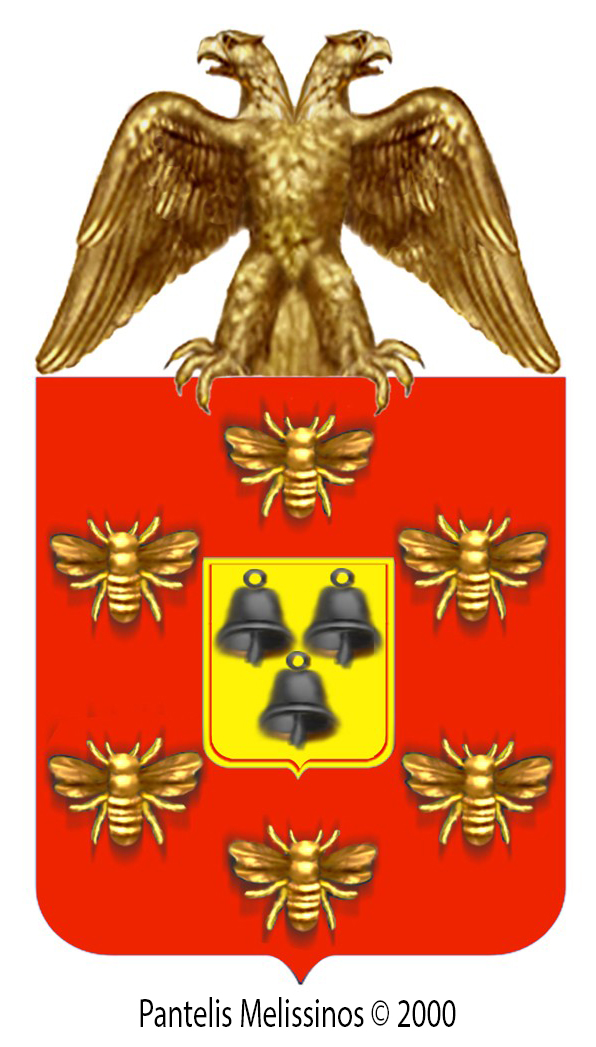
A Byzantine Lineage Across Empire, Legend, and European Memory
One of the most ancient and noble Greco-Roman Houses of The Eastern Roman Empire, related to many Eastern Roman and Western-European royal and aristocratic Houses.
Historical Forms of the Name – In historical records across Europe, the name Melissinos appears in several transliterated forms, including Melissenus, Melissino, Melissen, Misili, and Messilino. It is also recorded in names such as Misili De Novel or Messilino De Novel, forms associated with the Melissinos branch of Demetrias. Female forms of the name include Melissene, Melissena, Melusine, and Melusina, while the plural forms appear as Melissenoi or Melissinoi.
The House of the Melissinoi is traditionally presented as one of the old noble houses of the Eastern Roman, or Byzantine, world. Its history is connected with military command, ecclesiastical authority, imperial politics, aristocratic alliances, regional governance, and later European genealogical traditions.
THE RISE OF A BYZANTINE HOUSE — THE EIGHTH CENTURY
Michael Melissinos and the Anatolikon Theme
One of the earliest figures traditionally associated with the family is Michael Melissinos (8th century). He is remembered as a powerful magnate and Strategos of the Anatolikon Theme, one of the most important military provinces of the Byzantine Empire.
According to later family tradition, Michael Melissinos (8th century) was closely connected with the imperial court during the reign of Emperor Constantine V (741–775). His daughter, Eudokia (8th century), is said to have married into the imperial house, strengthening the position of the Melissinos family within the political and military elite of the empire.
THE MELISSINOI AND THE ICONOCLASTIC AGE — THE NINTH CENTURY
Theodotos I Kassiteras Melissinos, Patriarch of Constantinople
The influence of the family was not confined to the army or the imperial court. In the ninth century, Theodotos I Kassiteras Melissinos (815–821) served as Patriarch of Constantinople. His patriarchate took place during the difficult period of the iconoclastic controversy under Emperor Leo V (813–820).
As patriarch, Theodotos I Kassiteras Melissinos (815–821) was involved in one of the most divisive religious questions in Byzantine history: the conflict over the veneration of icons. His role illustrates the presence of the Melissinoi within both the ecclesiastical and political structures of the empire.
IMPERIAL KINSHIP AND DYNASTIC MEMORY — THE NINTH AND TENTH CENTURIES
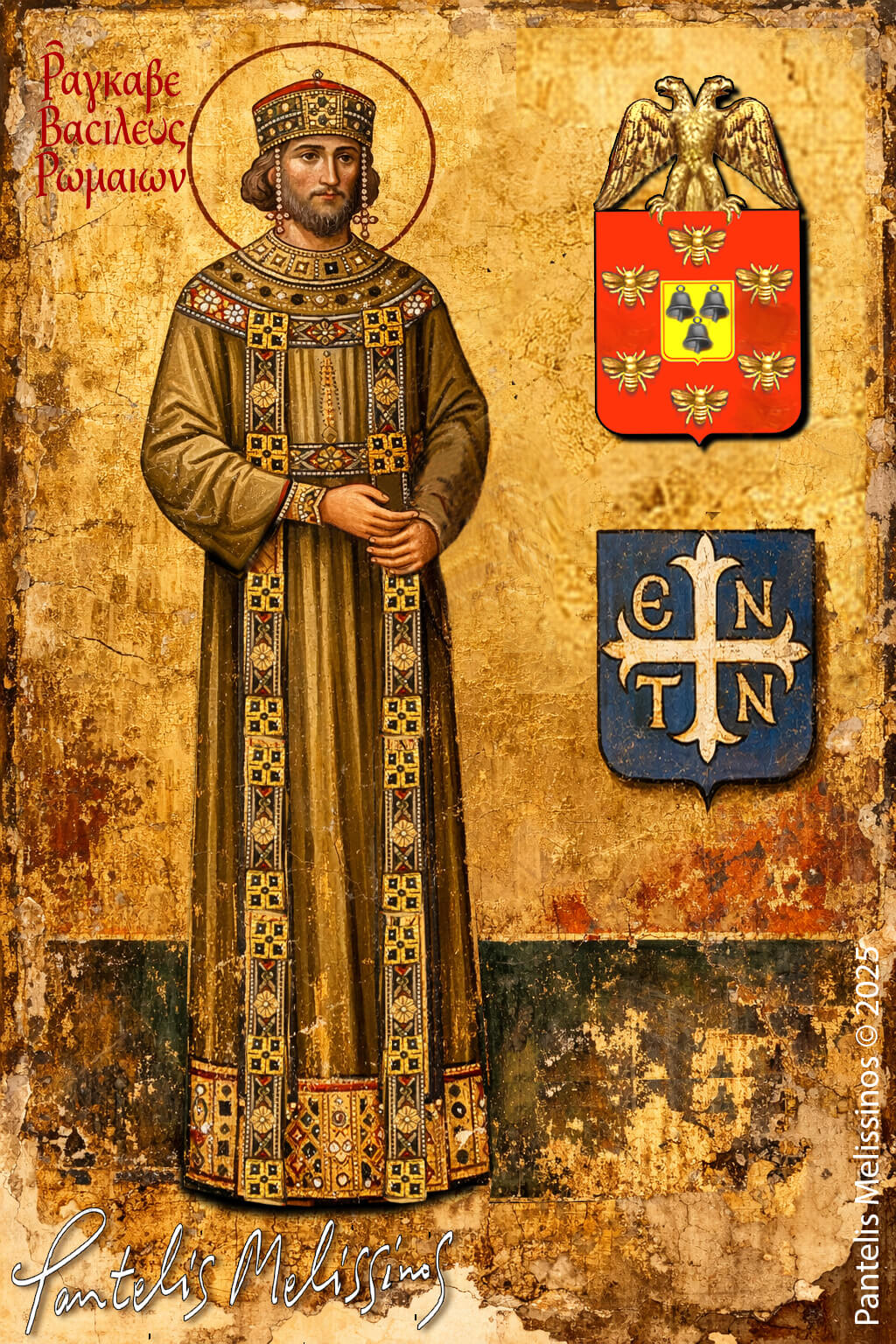
Emperor Rangabe is depicted with his ancestral coats of arms: his mother’s, from the Melissinos bloodline, displayed at the top, and his father’s, from the Rangabe bloodline, positioned below.
Lady Maria Melissene and Emperor Michael I Rangabe
The family tradition also links the Melissinos name to the imperial house through Lady Maria Melissene (9th century), the mother of Emperor Michael I Rangabe (811–813) and wife of the admiral Theophylaktos Rangabe (9th century).
Through this connection, the Melissinos family became associated with the imperial line. The tradition also reflects the importance of maternal descent and marriage alliances within Byzantine aristocratic society, where noble families often secured influence through dynastic connection as much as through military service.
Faith, War, and Martyrdom on the Eastern Frontier — The Ninth Century
Callistus Melissinos and the Sack of Amorium
Another figure traditionally associated with the family is Callistus Melissinos (9th century), described as Duke of Cologne in Cappadocia. He is connected with the wars against the Abbasid Caliph al-Mu‘tasim (833–842), during a period when the eastern frontier of Byzantium was under severe pressure.
According to tradition, Callistus Melissinos (9th century) was captured and executed after the Sack of Amorium (842), together with other noble prisoners. He was later venerated as a saint by the Orthodox Church, with his memory commemorated on March 6.
THE STRUGGLE FOR THE IMPERIAL THRONE — THE ELEVENTH CENTURY
Nikephoros Melissinos, Emperor-Pretender and Caesar
The eleventh century was a period of crisis and ambition in Byzantine history. Among the most prominent figures associated with the family was Nikephoros Melissinos (11th century), a Byzantine general and aristocrat.
During the instability that followed the Battle of Manzikert (1071), Nikephoros Melissinos (11th century) claimed imperial authority and became an emperor-pretender. His bid for power belonged to a wider struggle among the great military families of the empire.
After the rise of Alexios I Komnenos (1081–1118), Nikephoros Melissinos (11th century) relinquished his claim to the throne. In return, he received the high dignity of Caesar and retained considerable wealth and lands. His career demonstrates the political importance of the Melissinos name at the highest level of Byzantine power.
THE RECOVERY OF CONSTANTINOPLE — THE THIRTEENTH CENTURY
Alexios Melissinos-Komnenos-Stratēgopoulos and the Restoration of the Empire
In the thirteenth century, Alexios Melissinos-Komnenos-Stratēgopoulos (13th century) became associated with one of the most important events in late Byzantine history: the recovery of Constantinople from the Latins.
On July 25, 1261, Byzantine forces recaptured Constantinople, restoring the Eastern Roman Empire under Emperor Michael VIII Palaiologos (1259–1282). Alexios Melissinos-Komnenos-Stratēgopoulos (13th century) played a decisive role in this event, which marked the end of Latin rule in Constantinople and the return of the imperial capital to Byzantine hands.
THE CRETAN BRANCH AND THE SURVIVAL OF BYZANTINE NOBILITY — THE THIRTEENTH CENTURY
Andreas Melissinos and the Settlement in Crete
A Cretan branch of the family is traditionally associated with Andreas Melissinos (13th century), who is said to have settled in Crete during the thirteenth century. This branch belonged to the broader movement of Byzantine noble families into regional centres of power.
Crete became an important setting for the continuation of the Melissinos name. In later tradition, members of the family are connected with landholding, local authority, and ecclesiastical patronage on the island.
BYZANTINE MEMORY AND THE ART OF CRETE — THE SIXTEENTH CENTURY
Domenikos Theotokopoulos, El Greco, and the Cretan Tradition
The family tradition also links the Melissinos name with the artistic world of Crete through Domenikos Theotokopoulos, known as El Greco (1541–1614). According to this tradition, El Greco (1541–1614) was connected by descent or association with the Constantinopolitan branch of the Melissinos house.
After the Ottoman conquest of Constantinople (1453), families of Byzantine origin sought refuge in various places, including Crete. The Theotokopoulos family is said to have lived near lands connected with Melissinos relatives in Fodele, where the Church of the Theotokos was rebuilt in 1323 by Michael Melissinos (14th century) and his wife, Irene (14th century).
Whether approached as genealogy, local memory, or family tradition, this connection places the Melissinos name within the wider cultural history of Cretan and post-Byzantine art.
EXODUS FROM CRETE AND THE DISPERSAL OF THE FAMILY — THE SEVENTEENTH CENTURY
The Aftermath of the Ottoman Conquest of Crete
In 1669, after the Ottoman conquest of Crete, members of the Cretan branch of the Melissinos family are said to have left the island. Their descendants later appear in different regions, including Russia, Athens, and Tinos.
This movement reflects a broader historical pattern. After the fall of Byzantine and Venetian strongholds, Greek families often migrated, preserving their names and traditions in new political and cultural environments.
THE MELISSINOI OF DEMETRIAS — THE THIRTEENTH AND FOURTEENTH CENTURIES
Thessaly, Dynastic Alliances, and the De Novel Line
One of the important branches associated with the family is the Melissinos branch of Demetrias. This line is traditionally connected with major Byzantine dynasties and noble houses, including the Komnenoi, Doukai, Angeloi, and Palaiologoi.
Figures associated with this branch include Constantine Melissinos (1207–1255), Stephen Melissenos (1285–1310), Stephen Melissinos-Gabrielopoulos (1310–1331), and Anna Melissene (14th century). Through marriage and inheritance, the family became connected with Thessaly and with the Greco-Catalan world.
The name also appears in westernised forms, including Misili De Novel and Messilino De Novel, reflecting the transformation of Greek aristocratic names in Latin and Catalan contexts.
THE DUCHY OF ATHENS AND THE ACROPOLIS — THE FIFTEENTH CENTURY
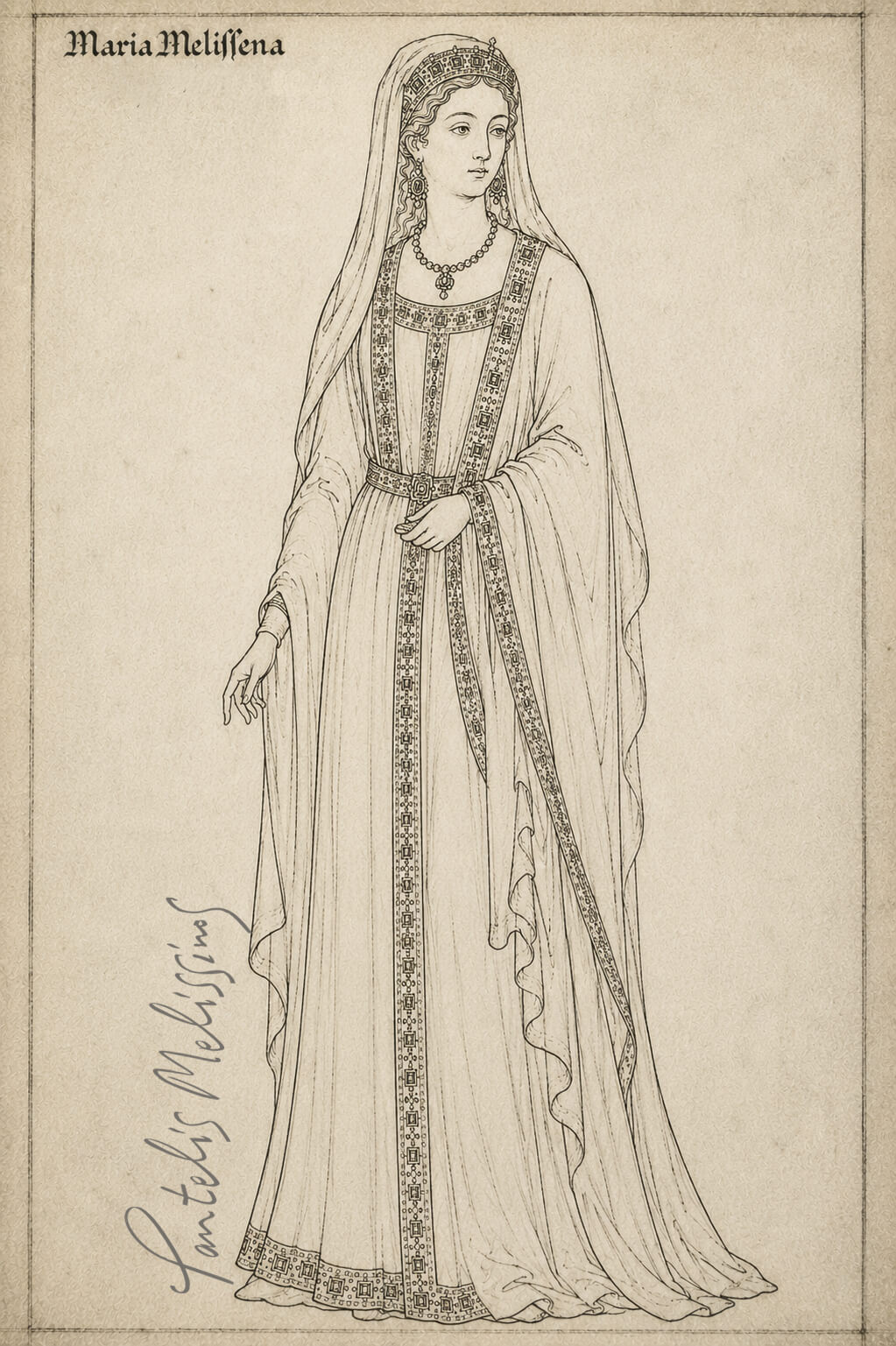
Maria Melissene (c. 1080–after 1136) Duchess of Athens A modern interpretation by Pantelis Melissinos inspired by medieval manuscript art, imagining one of the most distinguished women of the Byzantine House of the Melissenoi.
Maria Melissene, Duchess of Athens
The Duchy of Athens occupies a special place in the later medieval history of the Melissinos family. In this section belongs Maria Melissene (15th century), who must be distinguished from the legendary or archetypal figure of Princess Melissene / Melusine.
Maria Melissene (15th century) was the daughter of Leon Melissinos (15th century) and became connected with the ruling world of the Duchy of Athens through her marriage to Antonio I Acciaiuoli (15th century). After the death of her husband, she is traditionally remembered as Duchess of Athens.
Her association with the Acropolis of Athens and with the political life of late medieval Athens places her within the history of the city during a period shaped by Byzantine memory, Frankish rule, Florentine influence, and Greek aristocratic continuity.
THE LAST DIPLOMATIC EFFORTS BEFORE THE FALL — THE FIFTEENTH CENTURY
Gregory Melissinos-Stratēgopoulos and the Council of Florence
In the fifteenth century, Gregory Melissinos-Stratēgopoulos (15th century), a Cretan nobleman, confessor to Emperor John VIII Palaiologos (1425–1448), and political strategist, played a role in the final attempts to secure support for the Byzantine Empire.
He was involved in the Council of Florence (1438–1439), where efforts were made to unite the Eastern and Western Churches in the hope of gaining military assistance against the Ottomans. Later, he stood beside Patriarch Joseph II (1416–1439) during negotiations with Rome.
His son, Constantine (15th century), opposed his father’s position in 1450. By 1453, however, the empire had collapsed, and Constantinople fell to the Ottomans.
RESISTANCE UNDER OTTOMAN RULE — THE SIXTEENTH CENTURY
Makarios Melissinos and the Revolt of 1572
In 1572, Makarios Melissinos (16th century), Archbishop of Epidaurus, led a rebellion against Ottoman rule in Greece. His activity demonstrates the continued political and religious role of the family after the fall of Byzantium.
In this period, former Byzantine noble houses no longer served an emperor, but many continued to act through the Church, local authority, rebellion, diplomacy, and historical memory.
THE RUSSIAN BRANCH: PYOTR, IVAN, AND ALEKSEY MELISSINO
The Russian branch of the Melissinos family rose to prominence during the eighteenth century, at a time when the Russian Empire was expanding its military, political, and intellectual power under the reign of Catherine the Great (1762–1796). Like many Greek families connected with the wider world of the eastern Mediterranean, the Melissinos family entered Russian imperial service and became associated with the army, education, state administration, and the intellectual currents of the European Enlightenment.
The most celebrated figure of this branch was Pyotr Ivanovich Melissino (1726–1797), born Petros Melissinos on the island of Cephalonia, then under Venetian rule. Of Greek origin and connected with the old Byzantine family of the Melissenoi, he entered Russian service and rose to become one of the greatest artillery officers of eighteenth-century Russia. He was widely regarded as among the finest Russian artillerymen of his age and later received the rank of General of the Artillery.
Pyotr Melissino served under Catherine the Great and moved within the highest circles of Russian imperial, military, and intellectual life. Remembered as a confidant of Catherine the Great, he stood close to the world of power, patronage, reform, and Enlightenment culture that defined her reign. He was not merely a soldier of distinction, but a cultivated aristocratic figure, fluent in several languages and connected with the broader cosmopolitan world of eighteenth-century Europe.
His military reputation was established especially during the Russo-Turkish War of 1768–1774, one of the decisive conflicts of Catherine’s reign. As an artillery commander, Melissino contributed to the Russian victories at Khotin, Larga, and Kagul in 1770, where Russian forces defeated much larger Ottoman armies. His technical mastery and command of artillery made him a central figure in the modernization of Russian military power. After the war, he became director of the Artillery and Engineering Cadet Corps in Saint Petersburg, where he helped shape the education of future officers and strengthened the professional training of the Russian artillery.
Beyond the battlefield, Pyotr Melissino belonged to the esoteric and intellectual atmosphere of the Russian Enlightenment. He was associated with alchemical, Masonic, and philosophical circles in Saint Petersburg and was connected with the world of Giacomo Casanova, who encountered him during his travels in Russia. Melissino has therefore been remembered not only as a military reformer, but also as a patron of Casanova and a figure of the European culture of initiation, secrecy, and Enlightenment curiosity. Scholarly work on eighteenth-century Russian Freemasonry places him within the high-degree Masonic movements of Catherine’s Russia.
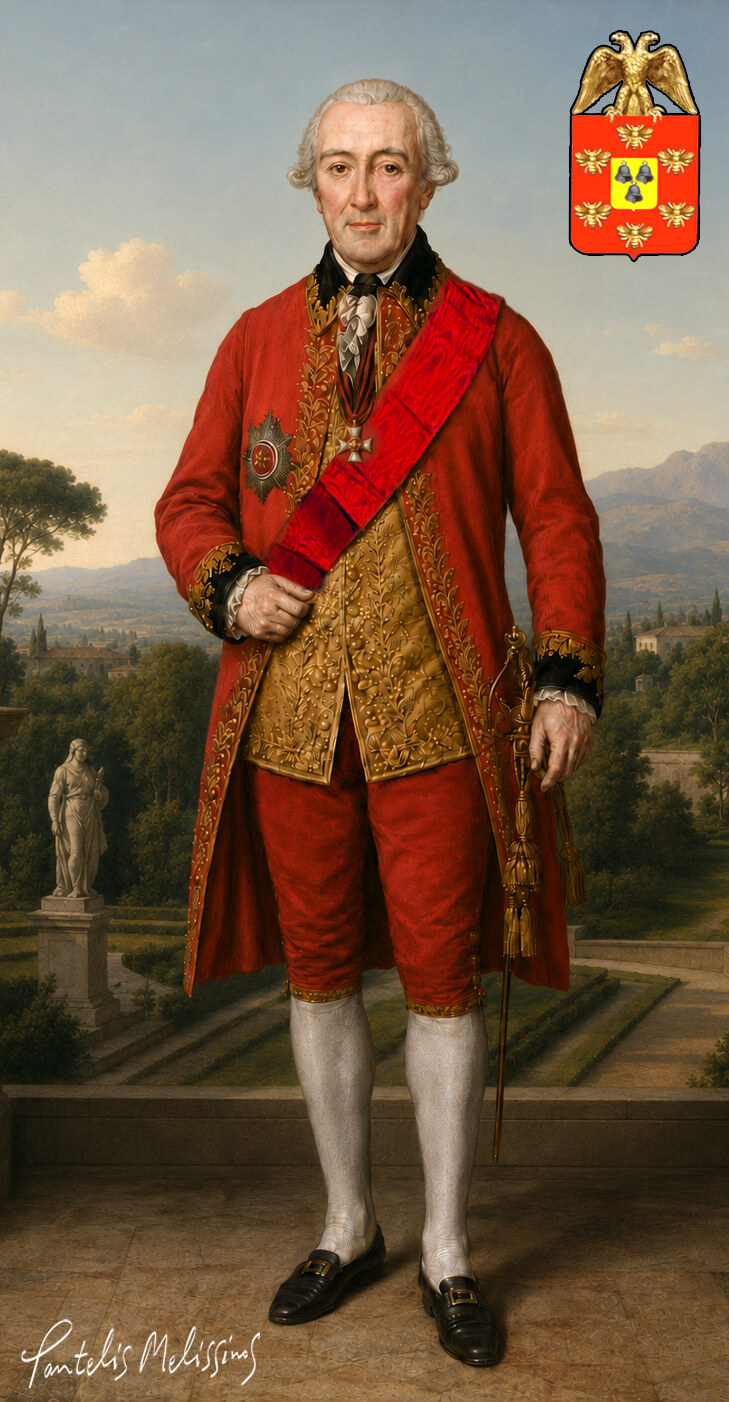
Count Pyotr Melissino (1726–1797): considered the Richelieu of Russia— confidant of Catherine the Great, patron of Casanova, & founder of the mid-1760s ‘Melissinos Rite’, forerunner of the Bavarian Illuminati.
In the 1760s, Pyotr Melissino founded the Melissino Rite, a high-degree Masonic system combining chivalric, spiritual, alchemical, and esoteric elements. Established before the foundation of the Bavarian Illuminati in 1776, the Melissino Rite was a precursor of the Bavarian Illuminati and stood among the earlier expressions of European Illuminist Freemasonry. Through this rite, Melissino’s name became connected not only with Russian artillery and imperial service, but also with the hidden intellectual history of eighteenth-century Europe.
Another distinguished member of the family was Ivan Ivanovich Melissino (1718–1795), brother of Pyotr Melissino. Unlike Pyotr, whose fame came chiefly through the army and Freemasonry, Ivan made his career in civil administration, education, and state reform. He was born into the Greek Melissinos family that had entered Russian service during the age of Peter the Great, and he was educated in the military and administrative institutions of the empire.
Ivan Ivanovich Melissino became closely associated with the early history of Moscow University, one of the great cultural institutions of imperial Russia. In 1757, he was appointed director of the university,
where he worked to improve education, strengthen academic life, and encourage literary and cultural activity. Later, in 1771, he returned to Moscow University as curator, helping to
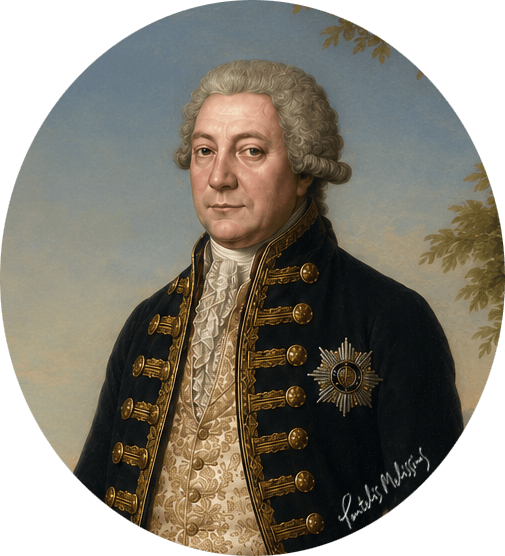
Ivan Ivanovich Melissino (1718–1795) Russian statesman & educator. Director of Moscow University (1757), & member of the Russian Academy (1783).
establish a boarding school and supporting the growth of literary societies. He was also connected with the wider intellectual life of Russia and became a member of the Academy of Russia in 1783.
Ivan also served in one of the most sensitive offices of Catherine’s reign. From 1763 to 1768, he was Ober-Procurator of the Holy Synod, the lay official who represented imperial authority in the administration of the Russian Church. In this role, he took part in the broader movement toward the secularization of church lands and the strengthening of state control over ecclesiastical affairs. His career therefore reflects the administrative and educational side of Catherine’s Russia: a world of universities, reforms, bureaucracy, and the transformation of traditional institutions under imperial authority.
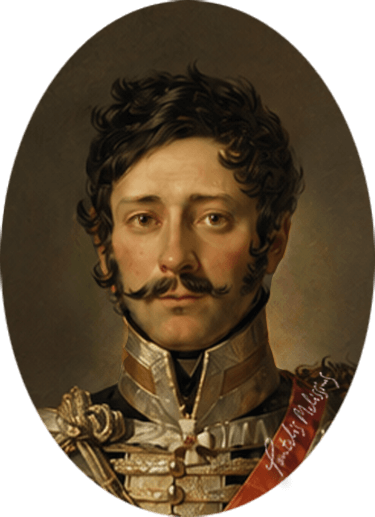
Aleksey Melissino (1759–1813) Lieutenant General in the Russian Imperial Army & a hero during the Napoleonic Wars.
The next generation of the Russian branch was represented by Aleksey Petrovich Melissino (1759–1813), son of Pyotr Melissino. He continued the family’s military tradition and entered the Russian Imperial Army, where he became known for courage and command during the great wars of his age. Unlike his father, who belonged to the military world of Catherine the Great and the Russo-Turkish wars, Aleksey belonged to the dramatic age of the Napoleonic Wars, when Russia’s struggle against Napoleon reshaped the destiny of Europe.
Aleksey Melissino first distinguished himself during the Russo-Turkish War of 1787–1792, especially at the famous storming of Izmail in 1790, the great victory led by Alexander Suvorov. This battle became one of the most celebrated Russian military achievements of the eighteenth century, and Aleksey’s participation placed him within the heroic military tradition of the Russian Empire.
He later served during the Patriotic War of 1812, when Napoleon invaded Russia with the Grande Armée. As a cavalry commander, Aleksey Melissino took part in the Russian resistance that gradually exhausted and destroyed Napoleon’s campaign. In the following year, during the German campaign of 1813, he fought in the wider allied struggle that carried the war beyond Russia and into Central Europe.
Aleksey Melissino fought at Bautzen, Reichenbach, and finally near Dresden, where he was mortally wounded in August 1813. His death came at the height of the European struggle against Napoleon, in the campaign that would soon lead to the decisive allied victory at Leipzig. He is remembered as a brave Russian commander and as the last prominent representative of the Russian branch of the Melissinos family.
Together, Pyotr Ivanovich Melissino, Ivan Ivanovich Melissino, and Aleksey Petrovich Melissino represent three different faces of the Russian branch of the family. Pyotr embodied military genius, imperial favour, Enlightenment culture, and esoteric Freemasonry. Ivan represented education, state administration, university reform, and the intellectual institutions of Catherine’s Russia. Aleksey carried the family name into the age of Napoleon, dying as a soldier in the wars that transformed Europe.
Through these three figures, the Melissinos name became linked with some of the central forces of eighteenth- and early nineteenth-century history: the rise of imperial Russia, the reforms of Catherine the Great, the development of Russian artillery and higher education, the secret currents of European Freemasonry, and the final struggle against Napoleonic power.
PRINCESS MELISSENE AND THE EUROPEAN LEGEND OF MELUSINE
A Separate Legendary Tradition
The figure of Princess Melissene (legendary tradition) belongs to a different section of the family narrative and should not be confused with Maria Melissene (15th century), Duchess of Athens.
In later European legend, Melissene appears under forms such as Melusina or Melusine. She becomes a semi-mythical figure associated with nobility, beauty, power, and transformation. In this tradition, her story is connected with medieval romance, royal genealogy, and symbolic ancestry.
The legend of Melusine was adopted and reshaped by several European noble houses, including the Lusignans, the House of Luxembourg, the House of Plantagenet, the Angevins, and the houses of Lancaster and York. These traditions used legendary ancestry to strengthen claims of prestige, antiquity, and dynastic legitimacy.
For this reason, Princess Melissene should be understood as an archetypal and legendary figure, while Maria Melissene belongs to the historical-political context of the Duchy of Athens.
THE SYMBOLIC ORIGINS OF THE NAME MELISSENE
Melissa, the Bee, and the Idea of Sacred Care
The name Melissene derives from the same root as Melissa, the Greek word for “bee.” In ancient and medieval symbolism, the bee was associated with order, fertility, sacred service, and royal authority.
The name also carries associations with care, nourishment, and guardianship. In mythic tradition, Melissa was connected with the care of Zeus, and therefore with the idea of sacred duty entrusted to a chosen figure.
This symbolic layer helped the name Melissene acquire a legendary resonance in later medieval narratives.
CECROPS AND THE MYTHICAL MEMORY OF ATHENS
The Serpent-King and the Ancient Origins of the City
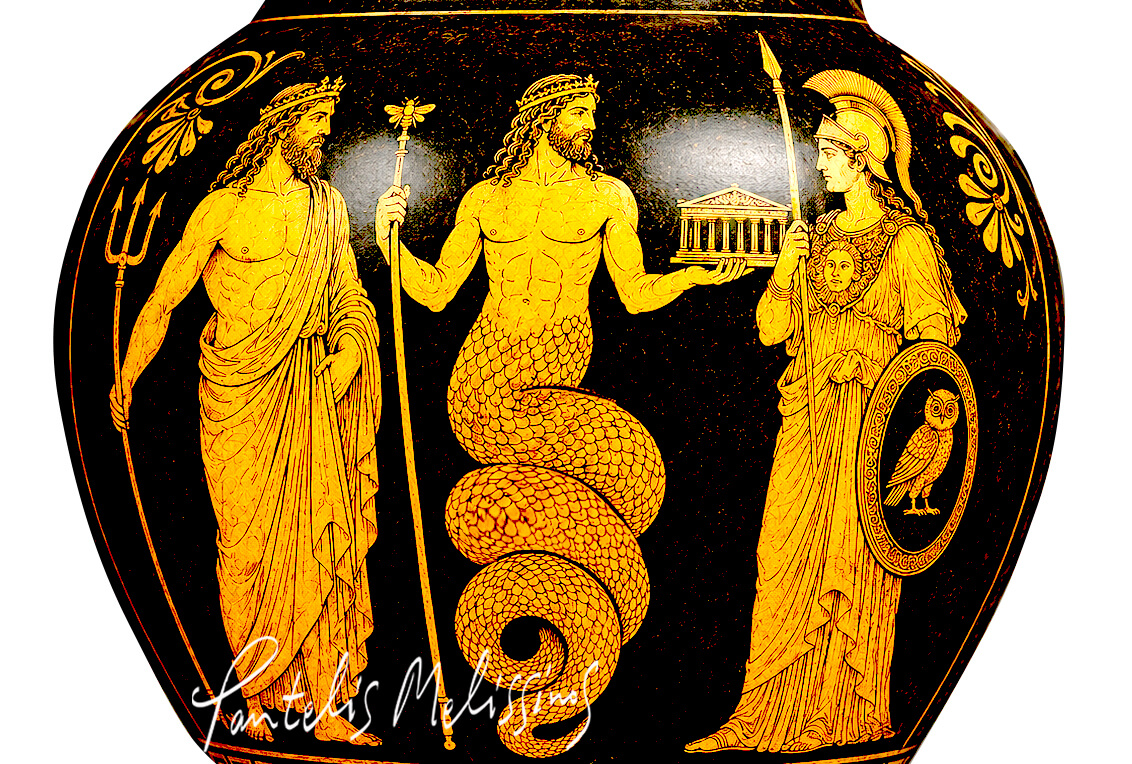
King Cecrops Between Athena and Poseidon — An ancient Greek vase-style illustration by Pantelis Melissinos, depicting the legendary contest between Athena and Poseidon for the patronage of Athens, as Cecrops offers the city to Athena and seals its divine destiny.
The wider legendary tradition connects the Melissinos bloodline with Cecrops, the mythical first king of Athens. Cecrops was famously depicted as part-human and part-serpent, a symbolic figure representing wisdom, autochthony, and the ancient origins of Athenian civilisation.
In this mythic framework, the serpent form does not merely suggest monstrosity. It symbolises primordial knowledge, guardianship, and the mysterious origins of sacred kingship.
This legendary association places the family memory within the oldest symbolic world of Athens.
MELUSINE
From Melissene to Melusine — A Western Transformation
From the shadows of the Eastern Roman Empire to the legends of the West… Princess Melissene rises — a figure of beauty, bloodline, and forbidden power hidden behind the secret corridors of history.
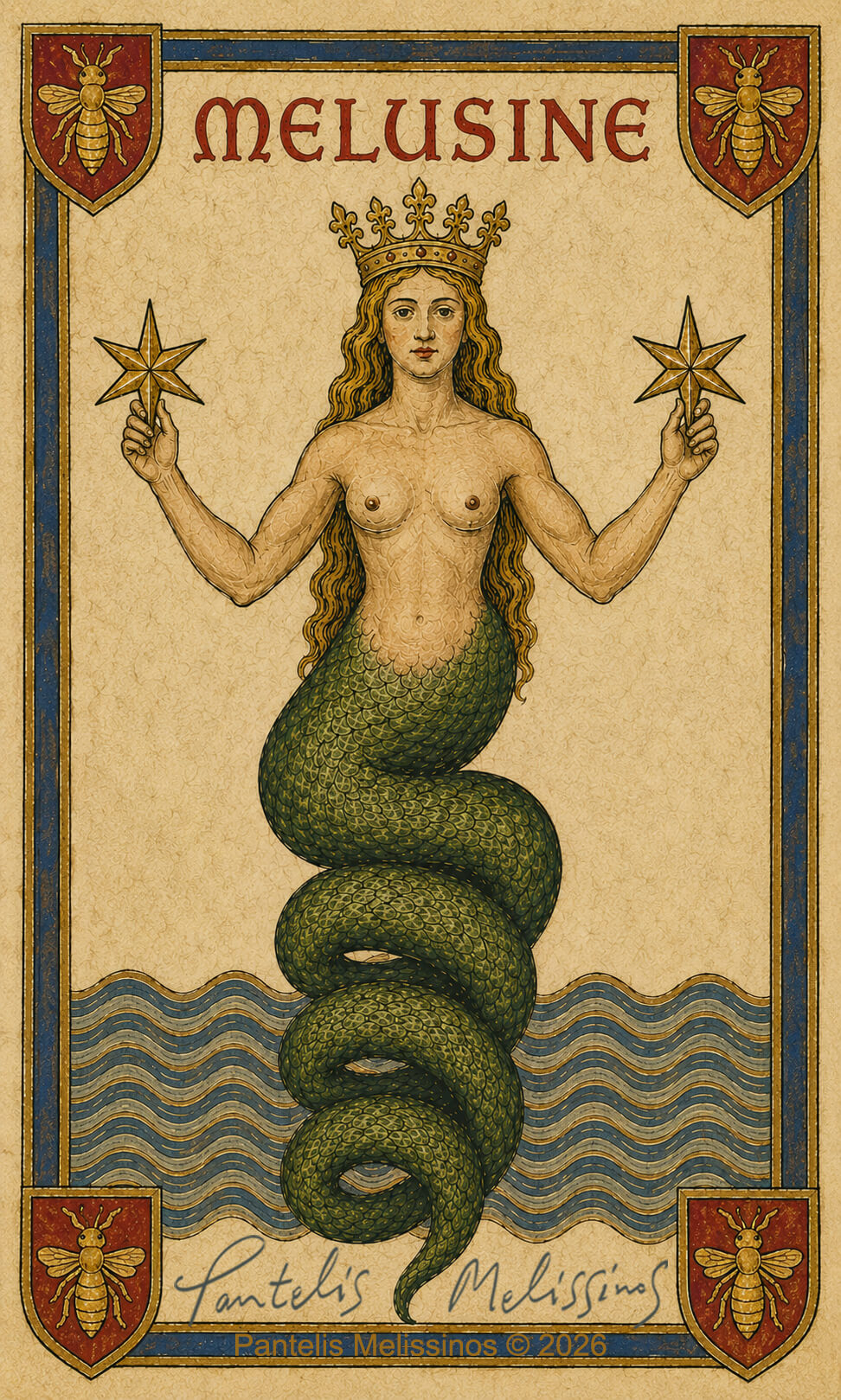
Melusine, the serpent-born memory of the noble Melissenus bloodline’s ancient origins
Over time, the name Melissene appears to have entered Western European legend in the form Melusine or Melusina. In this westernised version, the figure became a fairy-like woman whose beauty and power were joined to a supernatural serpent or dragon form.
The transformation from Melissene to Melusine reflects the way Eastern Roman, Greek, and medieval traditions were reshaped in the imagination of Western Europe. The human side of Melusine represented nobility, beauty, and civilisation, while her serpent form came to signify mystery, hidden power, and ancient origin.
THE MEDIEVAL LEGEND OF MELUSINE
Dynastic Myth, Secrecy, and Supernatural Ancestry
In the medieval legend, King Elinas of Albion marries the fairy-like Pressina. One of their daughters, Melusina, later marries Count Raymond under the condition that he must never see her bathing.
When Count Raymond breaks this condition and sees her serpent form, Melusina flees. The story became one of the most famous legends of medieval Europe, joining themes of nobility, secrecy, supernatural ancestry, exile, and dynastic foundation.
In later tradition, Melusine becomes a symbol of the hidden origins of royal houses and of the mysterious survival of ancient bloodlines.
WESTERN APPROPRIATION OF BYZANTINE PRESTIGE
From Eastern Roman Memory to European Romance
The glamour of the medieval Eastern Roman Empire deeply influenced the imagination of Western Europe. After the fall and fragmentation of Byzantine power, many western dynasties appropriated elements of Roman and Greek prestige, often reinterpreting them through their own genealogies and legends.
The legend of Melusine may therefore be understood as part of this wider process: the transformation of Eastern Roman memory into Western medieval romance.
HISTORICAL SIGNIFICANCE
A Family Name Across Empires
The history of the Melissinoi is best understood as a layered tradition. It includes Byzantine aristocracy, military command, ecclesiastical authority, imperial politics, medieval Athens, Cretan memory, Russian service, and European legend.
From Michael Melissinos (8th century) to Nikephoros Melissinos (11th century), the emperor-pretender of Byzantium; from Maria Melissene (15th century), Duchess of Athens, to the legendary Princess Melissene and the western figure of Melusine; the family narrative reflects the survival of Greek historical consciousness across many centuries.
The House of the Melissinoi, rooted in Byzantine memory and extended through later European traditions, remains a name associated with power, continuity, culture, and historical imagination.